
Each single day, companies generate a mountain of knowledge—gross sales numbers, web site clicks, buyer messages, app utilization, assist tickets, and extra. But, regardless of having all this data at their fingertips, many groups nonetheless depend on intestine feeling to make massive selections. That hole between knowledge and motion is precisely the place efficiency analytics steps in.
When finished proper, efficiency analytics helps you clearly see what’s working, what’s failing, and what wants fixing. It hyperlinks your effort to actual outcomes and replaces arguments primarily based on opinion with selections primarily based on proof. On this information, you’ll study what efficiency analytics is, why it issues, the differing types, and learn how to really use it in what you are promoting in a sensible, non-intimidating manner.
What Is Efficiency Analytics?
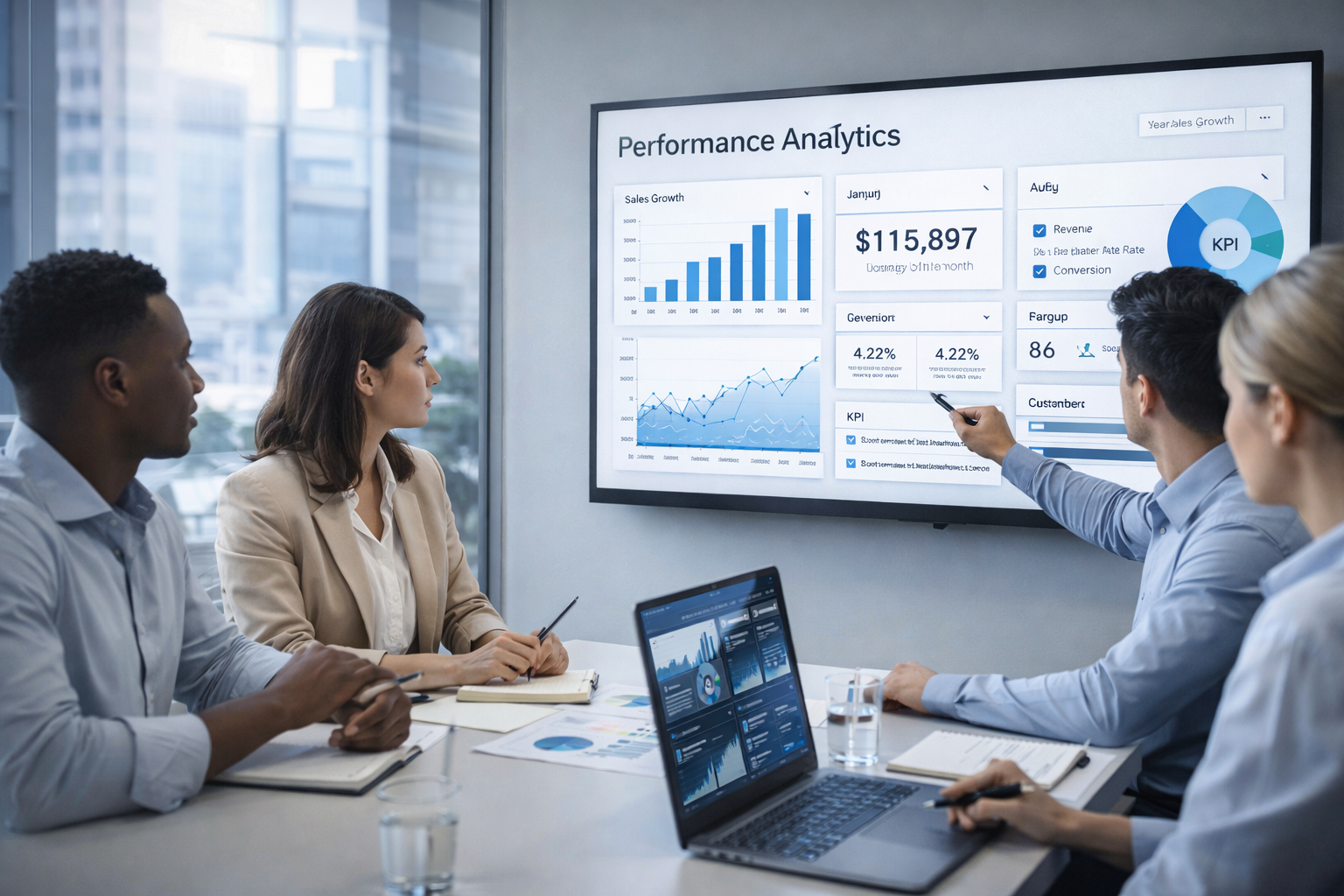
At its core, efficiency analytics is the follow of measuring, monitoring, and analysing how properly what you are promoting, groups, programs, or methods are performing over time.
As an alternative of guessing, you:
-
Outline what “success” means
-
Accumulate related knowledge
-
Examine outcomes in opposition to your objectives
-
Use these insights to enhance
It’s not about obscure “emotions” of progress. It’s about factual, measurable efficiency, whether or not that’s in gross sales, advertising, operations, finance, HR, or digital merchandise. When groups can see the numbers clearly, they acquire confidence within the selections they make.
Why Efficiency Analytics Issues for Fashionable Companies
Enterprise at this time strikes too quick for instinct alone. Buyer behaviour modifications shortly, new opponents pop up in a single day, and prices rise and fall unpredictably. In that setting, relying solely on intestine intuition is like driving at excessive velocity together with your headlights off.
Efficiency analytics helps you:
-
Cut back threat
You notice issues early as a substitute of realising months later that one thing’s gone fallacious. -
Make quicker, higher selections
Discussions shift from “I believe” to “The info exhibits”. -
Keep centered on what issues
As an alternative of monitoring each potential quantity, you think about metrics that truly hook up with your objectives. -
Construct accountability and belief
When efficiency is seen, everybody is aware of what’s anticipated and the way success is measured—with out leaders needing to micromanage.
Key Targets of Efficiency Analytics
A powerful efficiency analytics strategy often goals at 4 fundamental targets:
-
Visibility
Get a transparent, real-time image of how the enterprise is doing proper now—not final quarter. -
Alignment
Make certain every day duties assist long-term technique, so groups aren’t pulling in several instructions. -
Steady Enchancment
Use knowledge to study from what works and what doesn’t, then refine processes primarily based on actual outcomes. -
Threat Discount
Establish points early—whether or not in funds, operations, buyer satisfaction, or programs—earlier than they develop into expensive issues.
How Efficiency Analytics Truly Works
Consider efficiency analytics as a cycle, not a one-time challenge. It usually follows these levels:
Accumulate Knowledge from Key Sources
Knowledge flows in from all over the place, together with:
-
Monetary information
-
CRM and gross sales instruments
-
Buyer assist programs
-
Web site and app analytics
-
Operational programs and ERPs
The aim is to collect dependable, related knowledge slightly than gather all the things “simply in case.”
Analyse and Visualise the Knowledge
After you have the information, you employ instruments like dashboards, reviews, and charts to:
-
Spot patterns and developments
-
See how efficiency modifications over time
-
Examine completely different groups, merchandise, or areas
Visuals make it a lot simpler to show dense tables into clear tales.
Interpret the Findings
That is the place leaders and analysts work collectively to:
-
Establish which KPIs actually matter
-
Perceive the place efficiency is robust
-
Pinpoint gaps, bottlenecks, and alternatives
You’re not simply taking a look at numbers—you’re asking why these numbers look that manner.
Take Motion and Monitor
Based mostly on the insights, groups:
-
Regulate methods
-
Optimize processes
-
Modify targets or assets
Then the cycle repeats. Common check-ins preserve the organisation agile and responsive as a substitute of reactive and sluggish.
Forms of Efficiency Analytics (And When to Use Every)
Efficiency analytics shouldn’t be “one factor”—it’s a set of approaches that reply completely different sorts of questions.
Descriptive Analytics – “What Occurred?”
That is your start line. It summarises previous knowledge into comprehensible codecs like reviews or dashboards.
Use it to:
-
Observe final month’s gross sales
-
See web site site visitors developments
-
View buyer assist quantity over time
It doesn’t clarify why issues occurred, nevertheless it exhibits you clearly what did.
Diagnostic Analytics – “Why Did It Occur?”
Diagnostic analytics digs deeper into the explanations behind your outcomes.
Use it to:
-
Perceive why gross sales dropped in a selected area
-
Be taught why churn elevated amongst a selected buyer section
-
Uncover why manufacturing delays preserve occurring
It appears to be like at relationships between variables—like pricing modifications, seasonality, marketing campaign timing, or staffing—to clarify outcomes.
Predictive Analytics – “What’s Prone to Occur Subsequent?”
That is your “crystal ball”, powered by previous knowledge and statistical fashions.
Use it to:
-
Forecast demand
-
Predict churn or default threat
-
Estimate future income or stock wants
It doesn’t promise certainty, nevertheless it provides you possible outcomes, so you possibly can put together as a substitute of react.
Prescriptive Analytics – “What Ought to We Do?”
Prescriptive analytics takes issues a step additional by recommending actions, not simply predictions.
Use it to:
-
Counsel optimum pricing methods
-
Resolve the very best useful resource allocation throughout tasks
-
Select the simplest promotion or marketing campaign combine
It basically solutions: “Given what we all know, what’s the smartest transfer?”
Superior Analytics – “What Are We Lacking?”
Superior analytics makes use of extra complicated fashions (like machine studying) to uncover insights that fundamental reporting may overlook.
Use it when:
-
You’re coping with enormous volumes of knowledge
-
Your operations are complicated
-
You want deeper sample detection (e.g., fraud, anomalies, or hidden clusters)
Actual-Time Analytics – “What’s Occurring Proper Now?”
Actual-time analytics focuses on stay knowledge, providing you with a right away view of what’s happening.
Use it to:
-
Monitor stay web site site visitors
-
Watch system efficiency and downtime
-
Observe stay gross sales or order volumes
It’s particularly worthwhile in fast-moving environments like e-commerce, logistics, buying and selling, or vital IT programs.
Key Efficiency Indicators (KPIs) in Efficiency Analytics
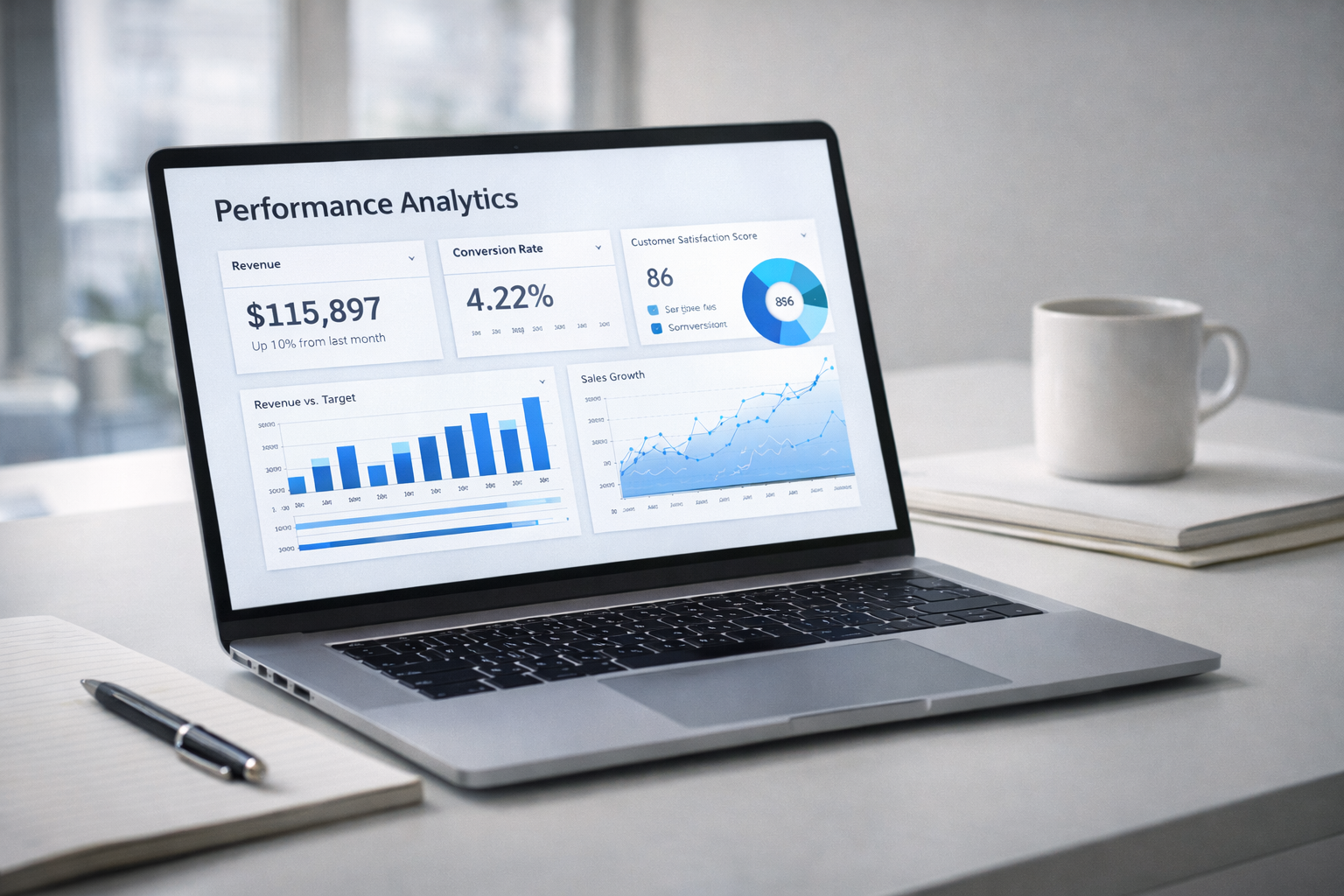
KPIs are the spine of efficiency analytics. They’re particular, measurable values that present how properly you’re doing in opposition to your targets.
Good KPIs enable you to:
-
Measure progress
-
Spotlight weak factors
-
Align staff with enterprise objectives
-
Construct a performance-driven tradition
Widespread KPI Examples
-
Income
Complete cash earned over a selected interval. -
Revenue
Income minus prices—how a lot you really preserve. -
Buyer Satisfaction (CSAT/NPS)
How pleased clients are together with your services or products. -
Worker Satisfaction or Engagement
How strongly staff really feel linked and motivated at work. -
Productiveness
Output generated per unit of time, value, or useful resource.
When staff know which KPIs they affect—and people KPIs are tracked transparently—they’re extra more likely to keep engaged and centered.
Main Advantages of Efficiency Analytics
When carried out correctly, efficiency analytics can rework how what you are promoting operates.
Higher Visibility Throughout Operations
Managers acquire a real-time view of:
-
How completely different groups are performing
-
Which processes are clean or caught
-
The place delays, waste, or bottlenecks exist
This readability turns guesswork into knowledgeable decision-making.
Stronger Knowledge-Pushed Selections
As an alternative of counting on instinct, leaders can:
-
Base methods on developments and proof
-
Justify investments with numbers
-
Keep away from expensive missteps attributable to assumptions
Knowledge turns into the impartial referee in strategic debates.
Greater Operational Effectivity
By recognizing inefficiencies, you possibly can:
-
Streamline processes
-
Take away or automate repetitive duties
-
Reallocate assets the place they’ve extra influence
The result’s typically decrease prices and better output with the identical or fewer inputs.
Clear Accountability and Honest Evaluation
With clear metrics:
-
Groups know the way their efficiency shall be evaluated
-
Leaders can monitor outcomes with out hovering
-
Efficiency critiques develop into extra goal, much less political
This builds belief and makes efficiency conversations extra constructive.
Steady Enchancment Tradition
Efficiency analytics encourages a suggestions loop:
-
Measure
-
Be taught
-
Regulate
-
Measure once more
This mindset helps your organisation keep adaptable in altering markets.
Higher Alignment with Enterprise Objectives
When metrics match strategic objectives:
-
Departments cease working in silos
-
Efforts are coordinated
-
Everybody strikes towards the identical outcomes
This improves communication and hurries up progress.
Sooner Response to Change
With well timed efficiency knowledge, you possibly can shortly reply to:
-
Shifts in buyer behaviour
-
Provide chain disruptions
-
System efficiency points
That agility might be the distinction between shedding floor and gaining an edge.
Widespread Challenges in Efficiency Analytics
After all, it’s not all clean crusing. Some frequent obstacles embody:
-
Poor Knowledge High quality
Incomplete, inaccurate, or outdated knowledge results in deceptive insights. -
Fragmented Techniques
Totally different instruments retailer knowledge in several codecs, making integration onerous. -
Talent Gaps
With out coaching, groups could misunderstand dashboards or misuse knowledge. -
Cultural Resistance
Folks used to engaged on “intestine feeling” could resist data-driven approaches until management champions the change.
Recognising these challenges early makes it simpler to plan round them.
Efficiency Analytics vs. Efficiency Value determinations
These two ideas sound comparable however serve completely different functions.
| Facet | Efficiency Analytics | Efficiency Value determinations |
|---|---|---|
| Focus | Enterprise processes, programs, outcomes | Particular person staff |
| Objective | Enhance effectivity, technique, and outcomes | Consider contribution and development |
| Knowledge Supply | Operational, monetary, and system knowledge | Supervisor suggestions, evaluations, information |
| Frequency | Steady or real-time | Periodic (annual/quarterly) |
| Method | Knowledge-driven and goal | Usually extra subjective |
| Final result | Insights for enhancing processes | Rankings, suggestions, and improvement plans |
Conventional Opinions vs. Fashionable Analytics
You can even evaluate old-school efficiency critiques with ongoing analytics:
| Facet | Conventional Efficiency Evaluate | Efficiency Analytics |
|---|---|---|
| Analysis Timing | Finished often | Steady monitoring |
| Foundation of Evaluation | Opinions and recollections | Actual, up-to-date knowledge |
| Focus | Previous efficiency | Present developments and future dangers |
| Accuracy | Vulnerable to bias | Extra goal and constant |
| Resolution Help | Restricted | Robust and actionable |
| Enchancment Fashion | Reactive | Proactive and ongoing |
Easy methods to Execute Efficiency Analytics in Your Organisation
Implementing efficiency analytics properly is all about construction and readability.
Begin with Clear Targets
Outline what you wish to enhance:
-
Productiveness?
-
Engagement?
-
Income?
-
Buyer satisfaction?
Clear objectives result in extra significant knowledge and fewer distractions.
Select the Proper KPIs
Decide KPIs that:
-
Immediately relate to your targets
-
Are measurable and trackable
-
May be influenced by your groups’ actions
Keep away from self-importance metrics that look good however don’t drive selections.
Accumulate and Combine Knowledge Correctly
Pull knowledge from:
-
Inside programs (CRM, ERP, HR, finance)
-
Surveys, suggestions kinds, efficiency instruments
Make certain it’s:
-
Correct
-
Safe
-
Constant throughout sources
The place potential, combine programs so that you’re not manually stitching knowledge collectively.
Construct Dashboards and Reviews
Use clear visuals to indicate:
-
Tendencies
-
Comparisons
-
Progress in opposition to targets
Dashboards needs to be comprehensible at a look, even by non-technical stakeholders.
Benchmark and Examine
Examine your efficiency:
-
Towards your personal historic knowledge
-
Towards trade averages, if out there
This context helps you recognize whether or not “good” is actually ok.
Examine Root Causes
If you see an issue, don’t cease at “what”—dig into why.
Use instruments just like the 5 whys or trigger‑and‑impact evaluation to search out the actual drivers behind efficiency gaps.
Analyse Efficiency Drivers
Mix:
-
Quantitative knowledge (numbers, developments)
-
Qualitative enter (suggestions from groups and clients)
This blended view stops you from misreading the information.
Spot Tendencies and Patterns
Search for:
-
Repeated dips at sure occasions
-
Constant overperformance in particular areas
-
Hyperlinks between completely different metrics
Usually, patterns inform you greater than single knowledge factors.
Plan and Implement Actions
Flip insights into concrete actions with:
-
Clear house owners
-
Timelines
-
Success standards
Then monitor progress and regulate if wanted.
Keep Steady Suggestions
Encourage groups to:
-
Query the information
-
Counsel enhancements
-
Share what they’re seeing on the bottom
This retains efficiency analytics human and collaborative, not simply numbers on a display.
Widespread Instruments Used for Efficiency Analytics
Many software program platforms enable you to gather, analyse, and act on efficiency knowledge throughout completely different enterprise areas, corresponding to:
-
IT and Service Operations: Instruments that monitor workflows, tickets, and repair ranges by means of real-time dashboards and reviews.
-
HR and Workforce: Platforms that monitor efficiency, engagement, objectives, and alignment between staff and enterprise targets.
-
Gross sales and Buyer Efficiency: CRMs that analyse pipelines, buyer touchpoints, conversion charges, and income developments by means of wealthy reporting.
-
Infrastructure and Knowledge Administration: Techniques that monitor uptime, storage, utilization, and reliability throughout your digital infrastructure.
-
Finance: Options that present deep insights into income, bills, money stream, budgeting, and monetary well being to assist decision-making.
You don’t want each device directly. The secret is selecting those that suit your dimension, complexity, and priorities.
Actual-World Use Circumstances of Efficiency Analytics
To make this extra concrete, right here’s how efficiency analytics performs out in several capabilities:
-
Gross sales
Observe income development, conversion charges, deal cycles, and pipeline well being. Then refine territory plans, pricing, and gross sales methods primarily based on what works. -
Provide Chain
Monitor stock ranges, supply occasions, and provider reliability. Use insights to scale back stockouts, minimize extra stock, and optimise logistics. -
Web site and Digital Merchandise
Analyse web page velocity, site visitors sources, person journeys, and engagement. Enhance UX, content material, and options primarily based on how customers really behave.
In each case, the sample is identical: measure → perceive → enhance.
Conclusion
Efficiency analytics provides companies one thing priceless: readability. It takes the chaos of uncooked knowledge and turns it into insights that information higher selections, sharper execution, and extra sustainable development.
When used constantly, it turns into a long-term aggressive benefit. Groups align round shared objectives, leaders act with confidence, and the organisation learns quicker than it used to. Over time, this regular, data-informed strategy lifts efficiency throughout each operate—from gross sales and operations to HR, finance, and IT.
For those who begin small, give attention to the fitting KPIs, and deal with efficiency analytics as an ongoing journey slightly than a one-time challenge, you’ll construct a enterprise that doesn’t simply react to the longer term—however actively shapes it.